


SEAI guide on revised EU Tyre Labelling Regulations
The Sustainable Energy Authority of Ireland (SEAI) has produced a guide on the revised EU Tyre Labelling Regulations.
The guide helps tyre dealers, tyre manufacturers, tyre importers, and vehicle suppliers and distributors to understand their obligations around tyre labelling.
It covers a range of topics including labelling at tyre fitting outlets, labelling online, and labelling in advertisements.
Tyre labels are very important in helping motorists to make well-informed purchasing decisions and to choose tyres that are safer, more fuel efficient and better for the environment.
Wet grip performance will always be a key concern for motorists, but the importance of good rolling resistance has grown recently, particularly as a consequence of the current spike in fuel prices and could help motorists to save money.
Information provided on the label about tyre noise is also of growing interest to motorists as sales of electric vehicles are gathering pace. Being quiet, noise from tyres is much more intrusive in electric vehicles, so it makes sense for electric vehicle owners to purchase tyres with a lower external rolling noise rating.
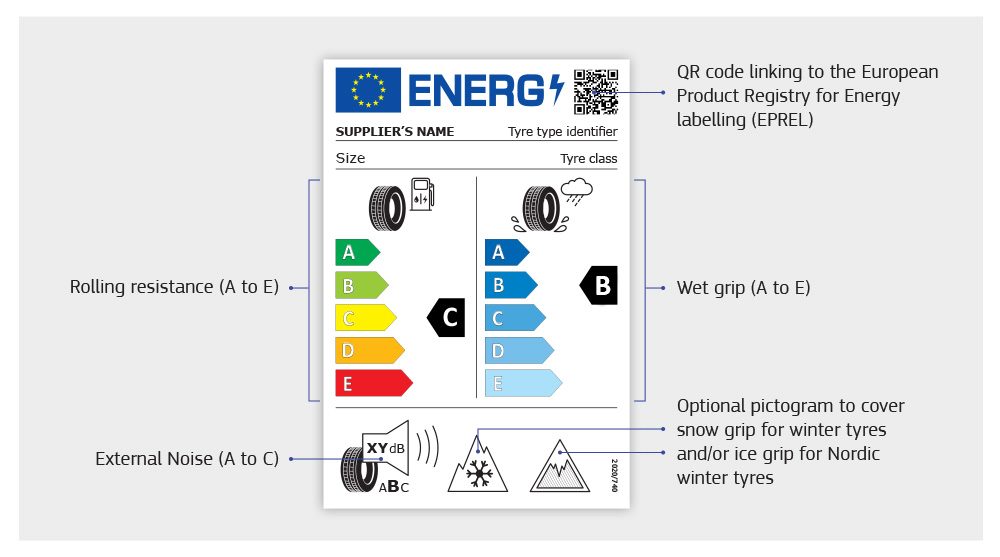
The EU tyre label format shown above came into effect in May 2021. The tyre label applies to C1 (passenger car), C2 (van
and light truck) and C3 (heavy truck) tyres. A product information sheet must also be provided.
Further changes to the label are expected in the future to provide motorists with additional information regarding tyre abrasion and mileage to help reduce microplastics in the environment.
There are different obligations for tyre suppliers, tyre distributors and vehicle suppliers and distributors as to how they must display or provide the label and provide product information sheet in outlets.
However, as a general principle the customer must get to see the tyre label before the tyre is sold to them. The guide provides further detail regarding what you must do in various different scenarios.
Tyre suppliers and tyre distributors must also provide certain information when advertising tyres, selling tyres online, selling through catalogues, telesales and in technical promotional materials.
In addition, tyre suppliers must enter information into the European Product Database for Energy Labelling (EPREL). This database has been set up to provide important energy efficiency information for various products (including tyres) to consumers and to facilitate market surveillance activities and enforcement.
You can find more information on product registration by clicking here.
SEAI undertakes market surveillance in relation to tyres to ensure compliance with the EU Tyre Labelling Regulation. Each year, SEAI assesses the compliance of several websites and advertisements and laboratory tests a number of tyres to ensure that the information shown on the label is correct. SEAI also inspects tyre retail outlets to ensure they are complying with the regulations.
Later this year, SEAI says it intends to undertake market surveillance of tyres using customs information to ensure tyres imported from outside the EU are compliant with the EU Tyre Labelling Regulation. If you would like to find out more, visit seai.ie/tyrelabelling